Roof Repair
What Makes the Best Silicone Roof Coating — and How to Choose the Right One
April 21, 2025 · Chaparosa Roofing · 4 min read
The silicone roof coating market has expanded significantly over the past decade, and not all products are created equal. If you’re evaluating coating options for a flat or low-slope roof, understanding the key performance variables helps you compare products accurately — and evaluate whether the contractor proposing the work is recommending a quality solution.
The Critical Spec: Solids Content
The most important performance variable in silicone coatings is percent solids by volume. When a coating cures, the carrier solvent evaporates, leaving only the actual silicone behind. A coating with 70% solids content leaves 30% less material than 100% solids — which means you need more product to achieve the same dry film thickness.
Premium silicone roof coatings are typically 90–100% solids. Budget alternatives often range from 60–75% solids — which means:
Thinner dry film from the same application volume
More material needed to reach warranty-required film thickness
Higher effective cost per mil of protection than the product’s price per gallon suggests
When comparing products or quotes, always ask about percent solids by volume and calculate cost per mil of dry film — not just cost per gallon.
Top-Tier Silicone Coating Manufacturers
Several manufacturers dominate the professional commercial roofing market with products that carry comprehensive warranties and proven field performance:
Tremco: GrafTech and AlphaGuard product lines. Industry-standard for membrane-over-foam and standard membrane applications. High solids content and strong installer certification program.
Sika Sarnafil: Premium single-ply and coating systems. European engineering with strong UV performance data.
Garland: High-reflectance silicone lines with 10- and 15-year NDL warranty options for certified applicators.
Henry / Bakor: Formulators with strong contractor certification programs and documentation support.
Rust-Oleum / Elastek: Available through building material distributors; appropriate for smaller applications with active installer support programs.
What these manufacturers share: independent laboratory testing data, certified installer programs, and warranty backup that means something when you make a claim 8 years into your coating’s life.
What Separates a Quality Application From a Poor One
Even the best coating fails if it’s applied incorrectly. The application factors that matter most:
Surface Preparation
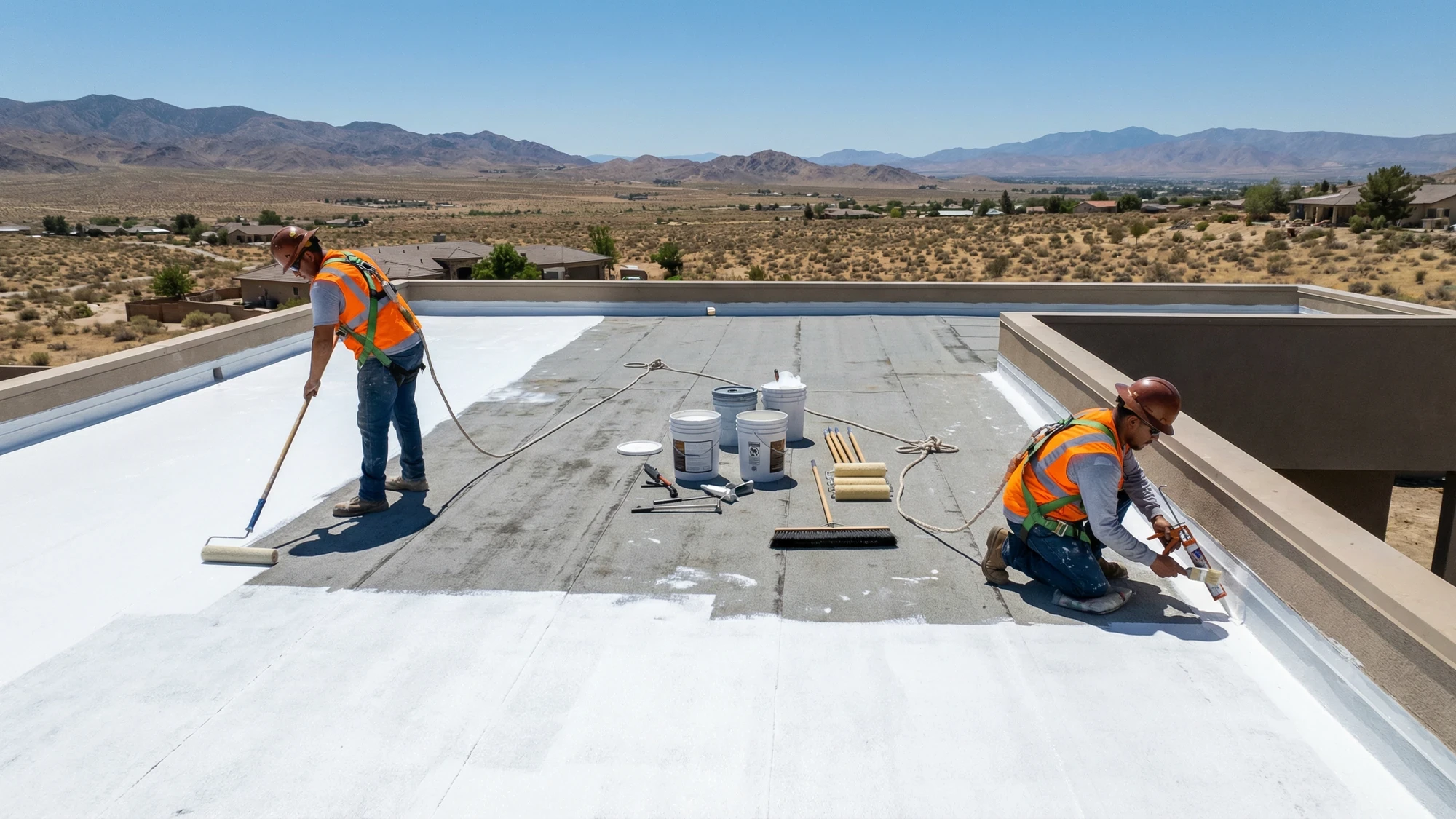
Silicone adhesion depends entirely on a clean, dry, primed substrate. Pressure washing, detergent cleaning, and thorough drying are prerequisites — not optionals. Coatings applied over contaminated or damp surfaces delaminate.
Moisture Survey
No coating should be applied over roofing that contains trapped moisture. Wet insulation beneath the membrane will continue to degrade regardless of the coating above it, and the warranty will be void when the insulation failure causes blistering or delamination.
Infrared thermal scanning or nuclear moisture detection surveys identify wet areas before coating — a responsible contractor performs this step.
Application Thickness
Most manufacturer warranties require a specific minimum dry film thickness — typically 20 to 30 mil for 10- to 15-year warranty coverage. Wet film gauges should be used during application to verify thickness.
Contractors who apply a single light coat to save labor and material while claiming warranty eligibility are applying the product below spec. Ask for documentation of wet film thickness readings from your job.
Seam and Penetration Treatment
Open or lifting seams should be treated with compatible tape or reinforcement fabric before the field coat. All pipe penetrations, curbs, and edge conditions should be coated to thickness with additional detailing as required by the manufacturer.
A coating with excellent field performance that fails at an untreated pipe penetration in year 2 is a contractor workmanship failure, not a product failure.
Questions to Ask Before Signing a Coating Contract
What specific product are you specifying? (Brand, product name, and product number)
What is the percent solids by volume?
What is the required dry film thickness for the warranty you’re quoting?
How will you verify application thickness during the job?
Are you performing a moisture survey before application?
Are you certified by this manufacturer to apply their system?
What does the manufacturer warranty cover, and who backs it — you or the manufacturer?
What surface preparation process do you use?
A contractor who can answer these questions fluently and in writing is doing the work right. A contractor who becomes evasive at “percent solids” is not the right contractor for a silicone coating system.
Chaparosa Roofing holds manufacturer certifications for the silicone coating systems we install. We perform moisture surveys before every coating project, document application thickness throughout the job, and register warranties directly with manufacturers. Contact us for a flat roof evaluation and coating assessment.